Unification as Principle, but not in Practice: The Place of Moldova with(out) Transnistria in Romanian Discourse
March 27th just passed, marking 108 years since the 1918 Union of Bessarabia with Romania, a celebrated day on both sides of the Prut River. This year, however, the anniversary carried added significance, making it worth recalling the event on January 11th, when the Republic of Moldova’s President, Maia Sandu, said “yes” to a potential referendum on the country’s reunification with Romania, amid increasing threats from an unfriendly East.
Beyond immediate reactions or personal preferences, it is worth taking a closer look at what Sandu aimed to achieve and to explore the current climate surrounding such a prospect. For the purposes of this assessment, we will turn our attention towards the other side of the Prut River and consider different segments of Romanian society, from the institutional and political seats in Bucharest to the wider public. Where, then, does this leave the elephant in the room – Transnistria?
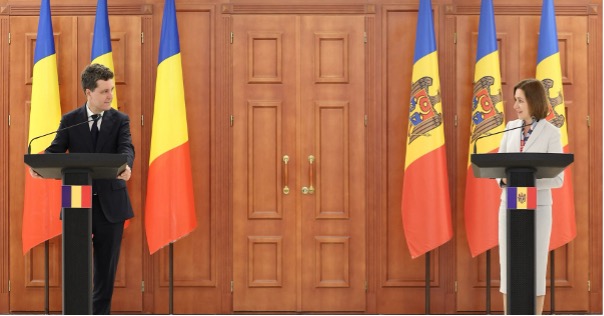
Image: Romanian President Nicusor Dan and Moldovan President Maia Sandu on June 10, 2025, in Chisinau, Moldova (Source: Worldview.strafor.com)
To understand this shift, we need to backtrack to 2016, exactly 10 years ago, when the incumbent President was then the opposition leader in Moldova and running for the presidency. That was when she first publicly supported the unification, even casting her own vote in favour. So, what makes it different now? Well, a war at the doorstep. That was the moment when the personal preference transformed into long-term strategy, one driven by necessity. And, that was precisely the place to draw the West’s attention.
The Russkiy Mir phenomenon is far from over. The Baltic states, Georgia and Moldova are all still in Russia’s sight. And what complicates matters in the latter two is that the Russian threat is not only external, but also internal, through pro-Russian narratives in the political discourse and breakaway Russian-backed territories. For the last two decades, we have witnessed Russia’s projection of aggressive hybrid campaigns on multiple “fronts”, and unless the international arena permits Russia to set a precedent, another will follow.
That said, acknowledging the limited ability for self-protection and orienting the country’s vision towards Brussels rather than Moscow, Sandu is simultaneously pursuing EU membership and supporting a unification with Romania, as a “fast-track approach” towards EU accession and a means to secure stability and security. However, as a recent analysis suggests, the unresolved status of Transnistria already represents a structural obstacle to Moldova’s EU accession, urging discussions of alternative or “two-step” integration scenarios. In this sense, the issue is not peripheral, but central and yet it remains largely absent from debates, let alone those pertaining to unification.
Looking back: Transnistria has not been part of Bessarabia
In the collective consciousness, Romania and the Republic of Moldova are deeply intertwined by common history, identity, and language, rooted in the Principality of Moldavia. However, the region east of the Dniester followed a different trajectory, being ceded to the Russian Empire in 1812 and later integrated into the Soviet Union in 1940 following the Molotov–Ribbentrop Pact. The post-WWII carve-up of the region saw Moscow create the Moldavian Soviet Socialist Republic. Caught up in between, Moldova evolved, over time, into a buffer zone in which two distinct narratives, one coming from Moscow, the other from Bucharest, were trying to win over the population. While for the Soviets, the utility of the region depended on the favourable climate for growing grapes, Romanians remained faithful to their pre-war historical and cultural lineage.
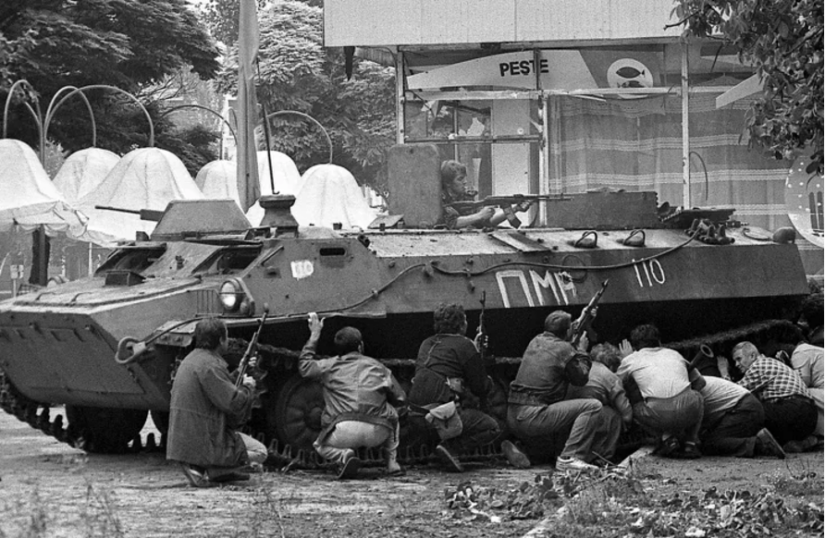
Image: Transnistrian War 1992 (Source: RadioMoldova.md)
The nineties witnessed changes in borders and regimes. Moldova proclaimed its independence, and, along with it, Transnistria fell under the Moldovan jurisdiction. However, in September 1990, and in the wake of a possible reunification and reform-oriented policies of pan-Romanian integration, the ethnic Russians in Transnistria sought independence, enticed by the popularised chant: chemodan, vokzal, Rossiya, (tr: “suitcase, train station, Russia”). Following months of fighting, the conflict reached a stalemate in the summer of 1992, resulting in a ceasefire and the de facto independence of Transnistria. In 1994, in an action more of checking the pulse of the society, then the Moldovan president, Mircea Snegur, in a referendum on Moldovans independence, the population have voted overwhelmingly (more than 90%) in favour, blowing a setback to ethnic Romanians seeking reunification with Romania.
Romania’s position throughout years: between principle and practical constraints
As a long-time advocate of Republic of Moldova, and the first country to support its independence, Romania has consolidated over time its position in contributing to the European future of Moldova and its citizens. Sprung from the communion of history, language and culture, the fundamentals of the relation, as dictated by the Romanian foreign policy, are as following: support for the European perspective of the Republic of Moldova and intensified bilateral cooperation.
Already in the early 1990s, questions regarding the possible union with Moldova rose, however they were treated cautiously in Bucharest. In 1991, then-Foreign Minister, Adrian Nastase, outlined a prospective three-stage model for reunification, beginning with cultural cooperation, followed by economic integration, and culminating in political unification inspired by the German model. While this framework suggested a structured pathway, it remained largely theoretical and was never translated into concrete policy.
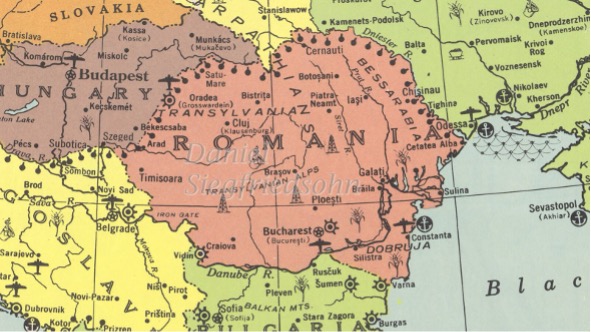
Image: The Greater Romania in 1940, before the Ribbentrop-Molotov Pact being enforced. (Source: Flickr.com)
Unification has since then periodically resurfaced in public discourse, often framed through similar references. As reflected in the 2012 declaration of Eugen Popescu, the President of the National Foundation for Romanians, “Everywhere, the German reunification model continues to be invoked as a precedent, shaping up unification as a provider of a rapid pathway to European integration”. In 1991, the Romanian Parliament drafted an official declaration, condemning the Molotov-Ribbentrop Pact as ab initio null and void– very relevant to our current discussion – without adopting a revisionist stance. In the years that followed, unification continued to surface in political discourse, particularly among right-wing actors, the Alliance of Romanians’ Union (AUR) and the Party of the Popular Movement (PMP) to name a few. Yet without any concrete steps in this direction. Even the 2018 parliamentary declaration, unanimously adopted on the matter of unification, remained only a symbol of fraternal solidarity rather than a policy commitment.
Meanwhile, Moldova’s trajectory has taken significant steps towards the West, gaining EU candidate status in 2022 and constitutionally committing to European integration in 2024. Despite the progress, persistent obstacles challenge Moldova’s accession, leaving the country at a considerable distance from full EU membership. Fast forward to recent times, and for all these reasons, voices are growing louder that reunification with or accession to Romania would be the shortest path to membership in the European Union. However, in practice, Bucharest remains cautious.
While the idea of unification is generally well received within Romanian society and broadly upheld by political factions, the unification is still not treated as a state project; this line argument sums up textbook geopolitical concerns of avoiding escalation with Russia and the issue of Transnistria, coupled with an amalgam of significant constitutional and economic implications of such a scenario. Importantly, this analysis does not seek to assess the material reality of these constraints, but rather to examine how that reality is constructed, articulated, and, at times, strategically deferred within the discourse itself as follows.
One question, but not on today’s agenda
Using thus the method of deconstruction across three segments of society, institutional, political and societal, the findings reveal not simply positions, but patterns of framing, prioritisation and avoidance; while there is a support for the idea of unification, almost like the carbon copies, among all segments analysed, unification as a process, is approached with caution. In other words, unification is framed as desired, but the question of Transnistria is broadly omitted from this, therefore in favour of European integration, as a concrete and achievable objective, as follows.
The institutional
When interviewed during a presidential visit in Poland, the incumbent Romanian president recalled that Bucharest formally declared its readiness to discuss reunification in March 2018, stating that this remains the official position of the Romanian state. However, it has not evolved into a concrete state policy. This distinction is yet important; Romania, in principle, receives the proposal favourably, but refrains from elaborating what such a process would entail in practice. This stance is further reflected in the public declaration Foreign’s Minister, Oana Toiu, in February 2026, reaffirming Romania’s support for Moldova’s EU accession. In the same press conference, she also called for the withdrawal of Russian troops from Transnistria, marking the first institutional reaction following Sandu’s statement, pointing to Transnistria, however as a matter of European security rather, and not as a prerequisite dialogue of unification.
Similar caution appears in the statements of the Honorary President Advisor, Eugen Tomac. Responding to Sandu’s declaration, he expressed the same desiderata of unification, however stressed that the initiative must come from Moldova, and any discussions about unification must be conducted with prudence and should not become an instrument of political confrontation. On the topic of current political sensitivity, in an interview, Cristian Diaconescu, former Minister of Foreign Affairs of Romania and Advisor to President Nicușor Dan, also positions himself, invokedthe 1975 Helsinki Act, emphasising that borders cannot be changed without the will of the population. In doing so, he reinforced Romania’s position regarding Moldova’s sovereignty and the primacy of the Moldovan people’s choice. Notably, while initially framing Sandu’s statement within a logic of “war” and “offensive communication”, which to us, the public, signals a strategic reading of the moment, one requiring cautious handling. Altogether, this reaffirms Romania’s established foreign policy stance: while acknowledging shared history, language, and culture, the focus remains on Moldova’s European integration and bilateral cooperation, not unification.
The political
In the political sphere, the reactions to Maia Sandu’s statements reveal, once again, that unification is supported as a principle, while European integration remains the shared feasible objective. Alina Gorghiu, PNL centre-right political member and vice-president of the Foreign Policy Committee, stated that Sandu’s remarks should be understood as an opinion rather than an official stance, while reiterating that any decision regarding unification ultimately rests with the citizens of the Republic of Moldova. From the Social Democratic Party (PSD), Titus Corlățean, president of the Senate’s Foreign Policy Committee, described Sandu’s declaration as “a half-step forward”, welcoming it as a positive signal while noting its limited scope. Extending the view, in a podcast published on the Romanian-Moldovan celebration day of unification, the European Parliament member, Siegfried Muresan, emphasised that unification is not on Romania’s public agenda, and the public opinion data on the matter is not considered particularly relevant in the current context.
Interestingly, the Transnistria question surfaced explicitly only in the position of former President Traian Băsescu, who in 2018 firmly supported unification, while explicitly excluding Transnistria, referring to it as “Ukraine’s problem”. Following Sandu’s declaration, he adopted a more careful tone, criticising what he considered premature or imprudent statements and highlighting the political sensitivity, security fragility, and lack of sufficient support for immediate unification. More assertive positions, particularly from the nationalist party AUR framed reunification as a matter of national security, arguing that increasing pressure from Russia turns unification into an immediate strategic necessity and saluted Sandu’s realpolitik approach, however they passed the ball into Moldova’s court, stating that serious action must come within the Moldovan Parliament or from the Moldovan population.
To extrapolate, a month after Sandu’s declaration, the often-contested right-wing party, SOS Romania, proposed a legislative project on the unification with Moldova, drawing on historical references to Northern Bukovina and Moldova, the principle of self-determination, and earlier international expressions of support for Romania’s potential reintegration. The proposal was rejected on constitutional grounds, reaffirming that unification cannot be initiated unilaterally by Romania through parliamentary or executive action. Instead, it would require international negotiations conducted at the level of the President as the state’s representative in foreign policy, thereby reinforcing the institutional posture already discussed, in which unification is acknowledged in principle but not translated into a policy.
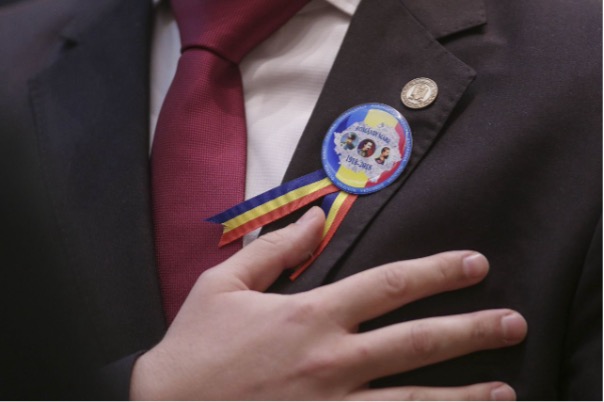
Image: Romanian politician wearing a commemorative badge marking 100 years since the 1918 Union, March 2018 (Source, Stirileprotv.ro)
Beyond the gestures of smaller, yet vocal parliamentary actors such as SOS Romania, and although such claims remain highly contested, they nonetheless reveal a subtle but significant pattern within the discourse. A sensitive distinction thus emerges across both institutional and political levels: who initiates unification matters. Elevated to the level of state policy and pursued as Romanian-led initiative, such a project would risk reframing Romania’s position as expansionist rather than self-determination, thereby undermining its positive standing in the international arena. It is precisely within this logic that UDMR president Kelemen Hunor, situates his position; acknowledging the symbolic appeal of unification, he argues that Romania’s priority should remain the European integration of the Republic of Moldova. He further warns that a referendum on unification could carry revisionist implications, a position which carries particular weight coming from a political actor representing a national minority. This helps explain why, across mainstream political parties, from PSD to AUR, and in line with the institutional posture, unification is consistently framed not as a Romanian initiative, but as a decision that must originate from Chișinău, both institutionally and societally.
At the same time, such a scenario could generate internal reverberations, particularly in regions with strong minority dynamics, such as the Hungarian-majority areas of Transylvania. In light of this statement, the emphasis placed on self-determination in the case of Moldova raises a broader, yet largely unaddressed question regarding its implications within Romania itself, however it remains beyond the scope of the present analysis. As expected, the question of Transnistria remains largely absent from political discourse. Except for isolated references, such as that of former President Traian Băsescu, the issue is neither integrated into discussions on unification nor treated as a defining constraint. This selective omission reinforces the pattern already identified, i.e. unification is sustained at the level of principle and systematically avoided in practice.
The societal
At the societal level, support for unification persists, yet it is articulated less as an immediate political objective and more as a distant, conditional, and structurally constrained aspiration. This is reflected in the survey conducted in Romania shortly after Sandu’s comment, with 56% in favour of the unification. However, within Romanian expert discourse, unification is consistently portrayed as a long-term and complex process, involving constitutional, institutional, political, military, economic, and European-level adjustments. Scholars in law and history therefore regard such a step as premature, calling instead for a focus on supporting Moldova’s European integration and maintaining regional stability. In this light, as legal scholar, Teodor Lucian Moga argues that initiating a serious discussion on unification in the current tense context could further destabilise the region, rendering it a counterproductive project.
A more critical reading is offered by historian Cosmin Popa, arguing that Sandu expressed concern about Moldova’s democratic resilience rather than advocating immediate unification. He views the exacerbated focus on unification as “a concession to Russian propaganda”, which paradoxically promotes Moldovan statehood in Chișinău while encouraging unification rhetoric in Bucharest, purely as a manipulation tool. Popa contends there is “much noise for very little”, since unification remains off the agenda in both capitals and Brussels. A similar line of reasoning is reflected in the position of European Parliament member Siegfried Mureșan, who downplays the relevance of public opinion surveys on unification, suggesting that such indicators carry no political weight in the absence of a state project on the matter.
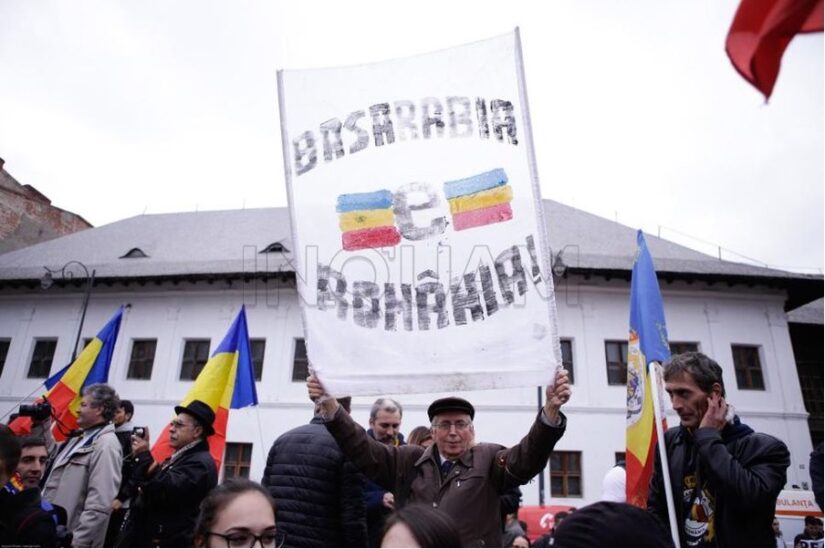
Image: The slogan ‘Bessarabia is Romania’ waved at the March Fight for Bessarabia, organized by the Unionist Platform Action 2012 in Bucharest, 2016 (Source: Inquamphotos.com)
Journalistic perspectives reinforce this pattern, though with a more constructive inflection. According to insightsprovided by Vitalie Cojocari (Euronews) and Mihai Isac (TVR Moldova) during a Romanian RFI interview, within their discussion, unification appears to be understood less as a sudden political act and more as a gradual process already unfolding through economic integration, educational cooperation, and increased mobility: “unification happens every day”, as the latter put it. They were among the few voices analysed to engage directly with the question of Transnistria, approaching it not as a geopolitically fraught abstraction, but as a lived experience, shaped by their Moldovan background. The situation, they argued, is not as dire as it is commonly portrayed. Transnistria already relies on EU exports and Romanian energy, pointing to a de facto economic integration that is already underway. What is missing, in their reading, is not factual readiness but political agency in both states.
Reactions within Moldova were notably more muted than in the past, pointing to a shifting political climate. According to a recent poll, only around one-third of Moldovan respondents favour unification, while a clear majority would oppose it. When asked about the motive behind Sandu’s comments, a fifth declined to answer. Another polling conducted two months after the President’s declaration, however, shifts the dynamic, increasing significantly to over 58%, any extra vote being conditioned on higher pensions, salaries, and improved living standards. The unification, in essence, lacks stable societal grounding and support remains conditional and economically bound rather than anchored in an identity-based consensus. As with the institutional and political levels, Transnistria is largely absent from societal discourse, with one notable exception. Both journalists, themselves Moldovan-born, were among the few voices analysed to address it directly, and within a different register.
Final reflections
The answer to where Transnistria sits in Romanian discourse is, in many ways, the answer to the broader question this analysis set out to explore. Across all three levels examined, institutional, political, and societal, unification is received favourably in principle and consistently deferred in practice; Transnistria is not the cause of that deferral, but it is its clearest symptom. As we have come to recognise, the current fragile security architecture puts Moldova in a vulnerable position, while Romania, perhaps more than before, appears to be tiptoeing away rather than towards the prospect of unification. Transnistria is largely absent when dialogue opens on this topic, reflecting not only strategic caution, but also the limited plausibility of unification as a concrete policy objective in the current context.
At the same time, the risks associated with a Romanian-led initiative help explain why it is framed as a decision that must originate from Moldova. In this configuration, the question of Transnistria is not ignored, but displaced, within a framework in which unification itself is neither imminent nor feasible, nor firmly grounded societally. Therefore, acting in the interest of European integration, while upholding Moldova’s sovereignty, the official Romanian position may, in effect, be quietly serving the very process it avoids naming. In this reading, “unification happens every day”, bringing with it closer economic cooperation, as well as political cohesion and social convergence.
Author: Cosmina U.