How Statelets Die: Lessons from Nagorno-Karabakh
Five years after the last war between Armenia and Azerbaijan, the traces of Nagorno-Karabakh live on mostly in the peripheries of Armenian life. In Yerevan, the old flags of the vanished de facto entity still flutter on a central traffic circle and cling to some of the parliamentary benches, pinned there by opposition lawmakers who refuse to let them go. They look less like political declarations now and more like relics, hanging on out of habit. With each passing season, the memory of the de facto state fades a little, slipping quietly into the background noise of the city.
Understanding why Nagorno-Karabakh disappeared matters not only to scholars of de facto entities. The lessons of this case speak to other similar statelets, especially Abkhazia, South Ossetia and Transnistria. They also emerged from the collapse of the Soviet Union and are now entering a difficult period as their main external supporter, Russia, is focused on its own war in Ukraine, and seems prepared for some major geopolitical shifts in the neighbourhood.
How long can such entities survive once their patron stops supporting them? How will the international system react, and what ultimately remains of a de facto state in this situation? These are the questions this blog post tries to answer, looking closely at the case of Nagorno-Karabakh.
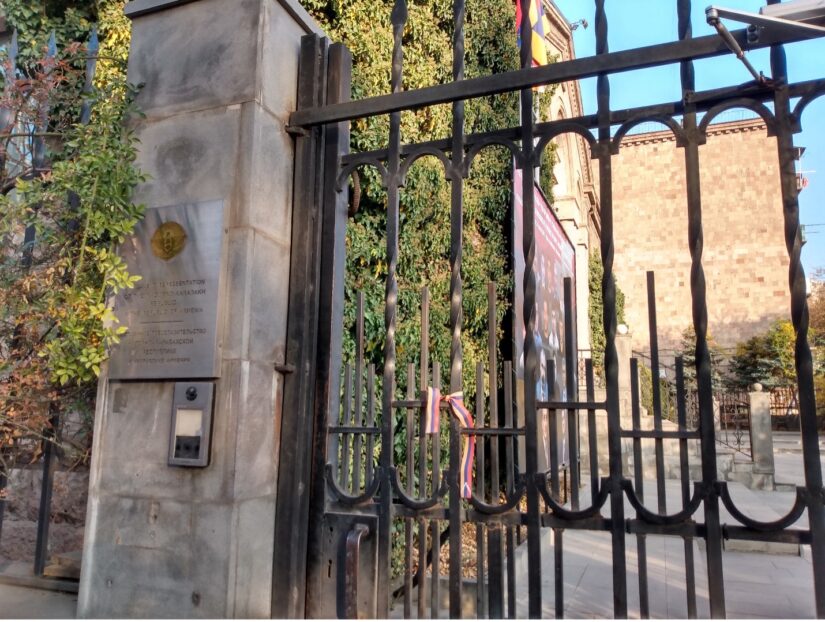
Image: The gate leading to the Representative Office of Nagorno-Karabakh Republic in Yerevan, post mortem (Source: Eiki Berg)
Armenian U-turn
For Armenia, letting go of Nagorno-Karabakh was an extremely difficult step. The story of victory in the war in the 1990s and the belief that Karabakh land belongs to Armenians shaped modern Armenian nationalism. The contemporary Armenian state was built around this idea, and its institutions reproduced it for more than three decades as they learned how to confront Azerbaijan and Türkiye.
In contrast to these concepts, Prime Minister Nikol Pashinyan has spent the last two years promoting what he calls the idea of the “Real Armenia.” His vision focuses on internal problems, strengthening Armenian statehood and abandoning nationalist territorial claims. The viability of this approach largely depends on the success of the peace process launched through the recent Washington accords with Azerbaijan.
Armenia began shifting responsibility for Nagorno-Karabakh almost immediately after losing the 2020 war. Yerevan still provided financial aid to Stepanakert – the former capital of the unrecognized entity that Azerbaijan renamed Khankendi, – but no longer played a decisive role in security matters. This was partly because Armenia had lost most of its army in the war and simply could not defend Karabakh anymore. It was also due to the lack of interest among foreign partners, who rather quickly accepted Russia’s peacekeepers as the new security guarantors in the region. Seen in that light, Armenia’s choice was logical and consistent with a broader pattern of concessions to a stronger opponent, something Armenia has had to do repeatedly over the past five years.
Some observers also point to Pashinyan’s personal experience. After coming to power in 2018 and until the 2020 war, he instructed the government to provide Nagorno-Karabakh with any financial or military assistance the de facto leadership asked for, including support previously denied by his predecessors. His goal was to reassure the de facto authorities that they had nothing to fear regarding both the conflict and their political status. Yet this signal seems to have been misunderstood in Stepanakert. Instead of showing loyalty, some figures within the de facto leadership began publicly challenging Pashinyan, his family members and his team. This also intensified tensions between Pashinyan and his domestic rivals in Armenia, many of whom came from Nagorno-Karabakh and retained personal networks there. The drama between Yerevan and Stepanakert never resolved and became another layer in the story of Armenia’s eventual withdrawal of support.
Russia drops its playbook
Russia was the other external actor that some in the de facto Nagorno-Karabakh leadership hoped for. Their expectations were fuelled by Moscow’s long experience of using statelets as political tools: recognition of two Georgian regions after the 2008 war, its support for Transnistria, and later its claims over Ukrainian territories. Some in Karabakh believed that one day Moscow would see value in their mountainous region as well and apply a similar strategy. To signal loyalty, de facto officials visited other Russian-supported entities, observed elections there and praised their legitimacy. After the annexation of Crimea, some people in Stepanakert even organized a celebratory concert. The arrival of Russian peacekeepers after the 2020 war strengthened the belief in the local pro-Russian groups that Moscow might eventually treat them like another protected enclave.
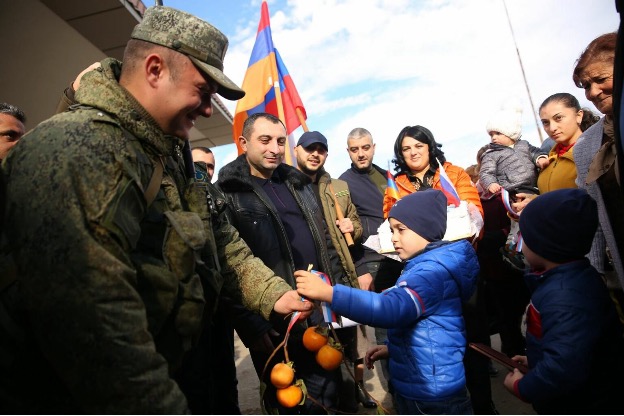
Image: Russian peacekeepers receive cake and other gifts from Karabakh Armenians shortly after they returned to the region following the 2020 ceasefire. (Photographer unknown)
But they soon discovered their hopes were misplaced. When the first serious incidents took place in Nagorno-Karabakh, Moscow neither intervened nor publicly addressed what happened. Some now say it was due to Russia’s distraction with its military invasion of Ukraine, but the problems in the Karabakh conflict zone started even before that. Representatives of other de facto regions quietly remarked that “Russians treated Armenians very differently.” Peacekeepers in Nagorno-Karabakh lived in temporary plastic cabins, unlike the solid military buildings Russia constructed almost immediately in Abkhazia and South Ossetia. Soldiers were not allowed to bring their families, open accounts in local banks or freely socialize with residents. Their commanders spent more effort demanding the removal of memorials they considered insulting to the Russian Second World War time memory than trying to influence local politics.
It is possible that if Nagorno-Karabakh had survived longer, Moscow might eventually have to shift toward its traditional playbook. Yet any such plan was undermined by Russia’s dominant desire to maintain good relations with Azerbaijan. Well before the 2020 war, some Russian officials were saying they wanted to avoid repeating the Georgian scenario, where recognizing Abkhazia and South Ossetia destroyed relations with Tbilisi and pushed Georgia firmly toward the West. Moscow did not want to risk losing Baku, and Karabakh simply did not offer enough geopolitical value.
A “blind” international system
During the 2020 war, a local activist and former de facto official who had lost his sight as a child in a mine incident walked through the aftermath of Azerbaijani attacks in Stepanakert filming short appeals in English. He urged the international community “not to be blind” to what was happening to the region’s Armenian population. The reaction he hoped for never came. Another former high-ranking de facto official later told me, “It felt like the world was even more comfortable once we were gone.”
Over thirty years, international organizations and foreign governments gradually reduced and eventually stopped almost all engagement with Nagorno-Karabakh. Contact with the de facto authorities was always difficult, but in the last decade it became nearly impossible to visit the region or even meet its representatives. Anyone who did risked being blacklisted by Azerbaijan.
Nagorno-Karabakh was not the only de facto entity facing isolation. Others have also struggled with pressure from the parent state and with the international system’s inability to adapt. Yet in contrast to the Georgian conflicts, where the EU created frameworks for “Engagement Without Recognition,” no such ideas emerged for Karabakh. Some Western governments funded civil society initiatives and humanitarian projects, but implementing them became harder each year until it eventually stopped altogether. In its final years, the region was seen as uniquely difficult and too politically sensitive for any new approaches. For Azerbaijan the danger was not that Karabakh might gain legitimacy, but that outside involvement could undermine the narrative of Armenian occupation.
Another major difference was the absence of any permanent international presence. Unlike other conflicts in Eurasia, no peacekeepers or monitoring missions were deployed to Karabakh after the war in the early 1990s. The OSCE had a special representative with a limited mandate, which included occasional trips to agreed positions along the line of contact. Few took the mechanism seriously. The Minsk Group co-chairs could still visit Nagorno-Karabakh and speak with de facto officials, but this did little to offset the region’s increasing isolation.
Without regular international engagement, Karabakh slipped out of daily attention. Local voices were no longer heard in Western capitals or global institutions. Advocacy came mostly from partisan foreign politicians and Armenian diaspora, which often irritated Baku rather than helping the situation. Over time the region became simply a name on the map with a bad reputation and no means to challenge it. When full-scale war returned, major global actors approached the situation strictly through the lens of territorial integrity, an approach reinforced by the Russian annexation of Crimea and its later invasion of Ukraine.
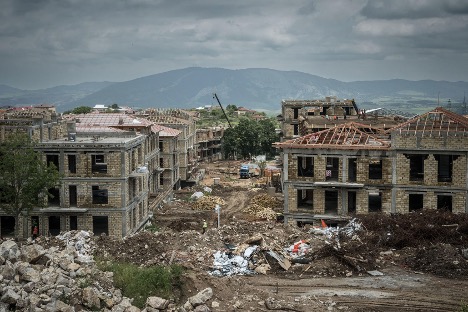
Image: Almost immediately after regaining control over the Nagorno-Karabakh conflict zone, Azerbaijani authorities launched a massive reconstruction effort, removing prominent buildings of the former de facto authorities along with many Armenian residential homes. (Source: Sergey Ponomarev/The New York Times, Shusha/i, 2023)
Internal systems did not matter
It is telling that discussions about Nagorno-Karabakh’s disappearance rarely touch on the quality of its governance, political freedoms or democratic values. For years these aspects were studied in detail to assess whether de facto entities could resemble functioning states. From a liberal perspective, many saw the improvement of governance as a way to justify their claims to recognition. After Karabakh’s fall, all of this was replaced by a legalistic narrative that focused solely on the responsibility of the de facto authorities and Armenia for occupying Azerbaijani territory and using its resources without authorization. No other discourse has emerged.
This rapid shift suggests that, unlike recognized states, the durability of de facto entities depends very little on their internal stability or performance. Nagorno-Karabakh could have become an economic success, yet it is now described almost exclusively as a criminal and clientelistic enclave that deserved to vanish. This may discourage other de facto regions from pursuing liberal reforms or better governance, since they are treated as “grey zones” regardless of their progress. If no one acknowledges improved elections or human rights, why invest in them at all? The main standard becomes the expectations of their own population, which places major limits on long-term development. Judging by the Nagorno-Karabakh case and with no systematized international monitoring and cooperation on freedoms and rights, de facto entities may be far more likely to end up as failed states.
Strength through dialogue with the adversary
The story of Nagorno-Karabakh also shows the importance of recognizing one’s own agency in conflict resolution. The region’s de facto leaders could have been in a much better position if they had started direct talks with Azerbaijan early enough to influence the outcome of the peace process.
Meaningful efforts to reach out to Baku began only after the 2020 war, when Nagorno-Karabakh was already surrounded by new Azerbaijani military positions and had lost almost all leverage. If the de facto leadership had started this process even a few years earlier, the trajectory might have been very different. For instance, in 2015 Russia proposed a revised peace plan that suggested the return of at least some surrounding territories to Azerbaijan. If Stepanakert had not obstructed the process and instead engaged seriously, the negotiations might not have solved the conflict entirely, but they could have widened the room for dialogue and produced a more stable arrangement.
Former de facto officials often insist they always supported dialogue and point to a long list of confidence-building proposals passed to the OSCE Minsk Group co-chairs. Yet most of these ideas were not aimed at genuine engagement but at slowing down the process and strengthening their own status. Had Stepanakert truly recognized the need for real talks and been willing to take risks, those talks would have happened. Even issues such as the detained ethnic Azerbaijanis held in Karabakh for years could have become an entry point for meaningful negotiations, but the de facto authorities refused to release them despite repeated visits from Baku’s envoys.
Perhaps the main lesson from Nagorno-Karabakh’s disappearance is the need to approach reality with clear eyes and search for genuine opportunities to negotiate with the other side. The status quo surrounding statelets can change quickly due to shifts in global politics. De facto entities cannot afford procrastination, especially given their vulnerability and incomplete international status. Their chances of avoiding sudden collapse increase when they communicate effectively with their adversaries, listen to their demands and prepare to offer concessions and new ideas. To avoid losing everything, one must at least be willing to give up at least something.
Author: Olesya Vartanyan